Thursday, April 20, 2017

Propaganda

1. Propaganda, in my words, is advertisement that uses specific elements to persuade audiences into doing whatever they say.

2. Link the particular doctrines or principles propagated by an organization or movement.

3. Link In the first image, the colors are very dull and almost sad. The artwork is in a sort of style that seems to suggest gothic tragedy. The font used is very bold and "in your face".
 
With the second poster, there is no color except for the cross in the background. The poster seems to suggest religious imagery.

The third poster draws attention to the dead soldier in the middle, and the red text at the bottom making the audience feel guilty about not buying liberty bonds. It also emphasizes the harshness of battle with the art style.

4. The artist of the first poster is very clearly to get people to buy government bonds, but they are specifically intending to make the audience feel bad for mothers and children.

The second poster is also presented with a clear intent: to guilt people into giving up "every cent they have" to the government for the war. They also have a target audience: religious people and women.

The third poster has a clear target audience of men, and they also use the guilt tactic to make people feel like they need to give money to the government.

5. The target audience of the first poster is people who have a heart for mothers and children, as well as people who are mothers or who has children.

The second poster seems to target religious people and women.

The third poster is very clearly targeting men, as the dead male soldier is supposed to trigger males into feeling sympathy for him.

6. I feel that taxpayers' money should not be used, mainly because it is not my duty as an American to be convinced of something, therefore I should not have to pay for it.

7. I think that the federal government felt the need to invest in propaganda at the time because they felt that there was a significant amount of convincing to be done. Most of the country was divided by the morality of the situation.

Thursday, April 13, 2017

Hawaiian: The Legend of Eddie Aikau

From what our history textbooks may convey to us, we receive the American perspective of imperialism. But from the film, we get a new perspective: the point of view from the colonies themselves. This is incredibly interesting because while we might think that the annexation of Hawaii was beneficial, there was another side that was rather closeted. With this film, we get a chance to understand what life was like as a native Hawaiian during the profusion of Americans claiming their land. From Eddie Aikau's perspective, we get to see how his surfing life was affected by these newcomers, and learn that for every story, there is another side that is not always as apparent.

Image result for eddie aikau surfing
Eddie Aikau surfing on Waimea Bay

Monday, April 3, 2017

"How do you analyze a political cartoon?"

So from what I know, I believe that one should go at a political cartoon the same way one would analyze a poem or work of art. Start by pointing out the obvious, making simple observations about the images of the cartoon. Then, continue by identifying what those observations could symbolize in the context of the cartoon. From there, you can infer what the artist is making a statement on, and determine what that statement is.

http://www.loc.gov/teachers/classroommaterials/presentationsandactivities/activities/political-cartoon/cag.html

From what this guide says, I was pretty close to the actual way of doing it, but one major thing I forgot is exaggeration. Political cartoonists use exaggeration as a way to identify specific people by using the most defined features and making them more defined.
Image result for philippines war political cartoon
Philippines Conflict Political Cartoon

Image result for spanish american war political cartoon
Spanish American War Political Cartoon
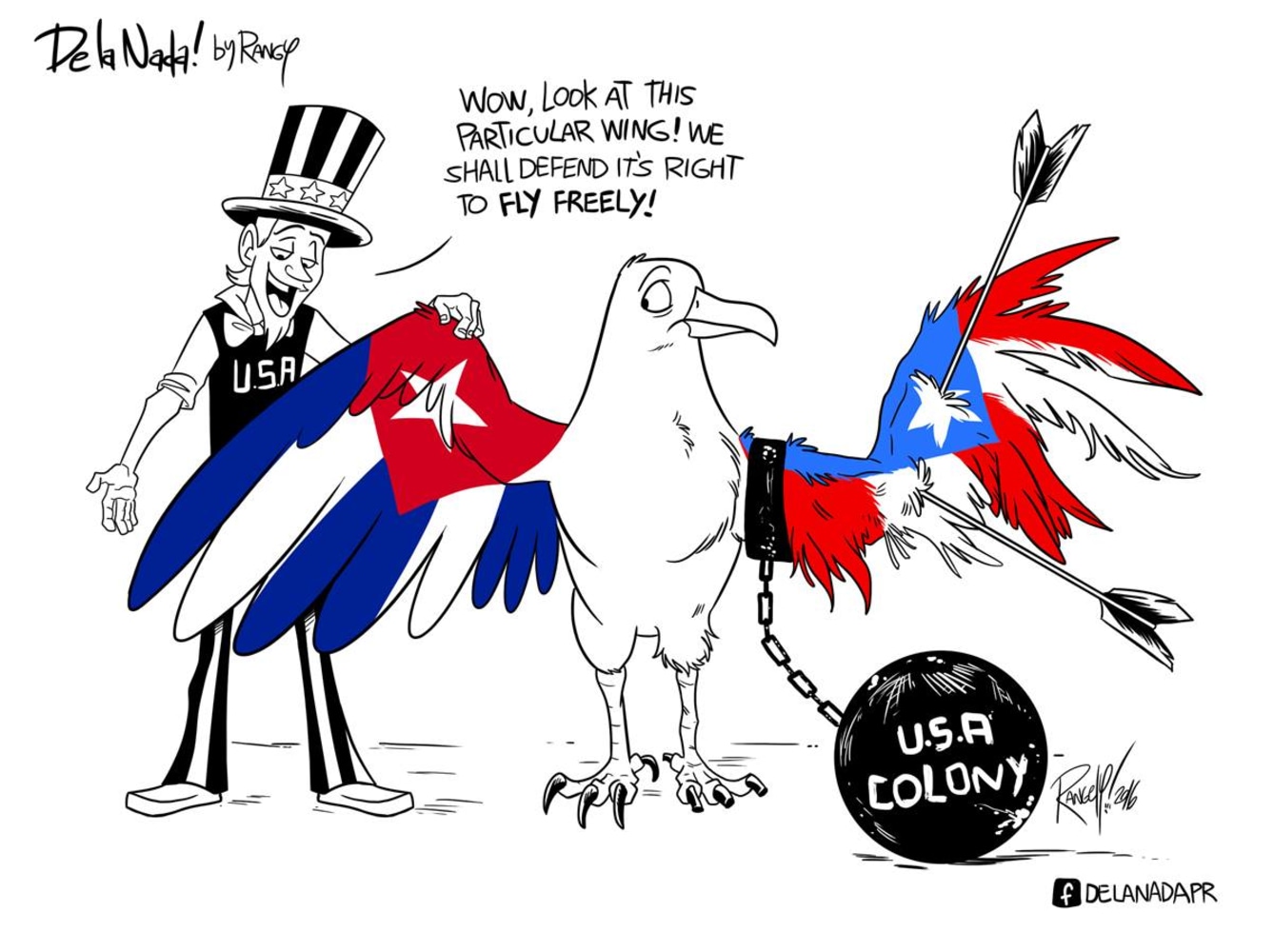
Image result for puerto rico political cartoon
Colonization Political Cartoon
1. Some of the first things I noticed about this cartoon were that it made a clear distinction of who represented who. It has Uncle Sam on the left, Emilio Aguinaldo, the leader of the Cuban rebellion, on the group (made clear by his hat on the ground next to him), and the man in the back is Spain. The cartoon also contains a subtitle that is difficult to read, which is from Uncle Sam to Aguinaldo saying, "See here sonny, Whom are you going to throw those rocks at?". This subtitle emphasizes the patronization of the US towards the Cuban rebellion force. The image also shows the power that the US has over Cuba by the physical stature of Uncle Sam. 

2. This cartoon illustrates the United States "protecting" Cuba from Spain as we entered the Spanish-American War. It shows Uncle Sam, representing America, protecting a woman with a label "Cuba" with an American flag, from the Cuban patriots. There isn't too much to say about this one, but it is clear that this represents the United States helping the Cuban rebellion against Spain. 

3. This last cartoon is about effect colonization has on the country as a whole. The artists makes it very clear that colonization is holding down the bird that represents the country's freedom, and that the bird cannot fly without both wings. It also emphasizes that Uncle Sam, who in this case represents the US government, is neglecting the broken wing, and is only paying attention to the perfectly good wing.


Tuesday, March 21, 2017

Civil Rights Act of 1964

The main things that the act physically banned was segregation in voting registration, segregation in schools, workplaces, and public accommodations.

As of today, the act is significantly more enforced. But back then, they struggled with the resistance to this act: specifically with the public accommodation clause of the act. The South used the argument that the government should not have any influence on independent businesses and that they cannot force businesses to serve black customers, but ultimately were overruled.

I believe that these sorts of racist behaviors definitely exist today, but the specific actions that are in the Civil Rights Act of 1964 are not. At this point, it comes down to the difference between the equal opportunities that the government is providing and the attitude of the people. The government can only go so far as to create these acts that ban racist behaviors until it begins to infringe on constitutional rights. Then, it is up to the people to end racism.

I felt that the movie definitely shed some light on a subject that I was not previously aware of, and showed me how important this event was in the Civil Rights Movement. It definitely clarifies, for me at least, that this is not just some field trip that we are taking because it is close by, but because it is something that is important on a national, and even global level. I'm expecting that this idea will become even more apparent when I actually get to be in the places that these events occurred.

https://en.wikipedia.org/wiki/Civil_Rights_Act_of_1964#Continued_resistance


Image result for martin luther king jr
Martin Luther King Jr.

Wednesday, March 1, 2017

Progressivism Research

"The Public Health Service is in the midst of one of the biggest health programs ever"

"Under the direction of Dr. Louis I. Thompson, the work of eliminating 'health hazards' in the department is going on as the newest branch of activity of the Government service."

Kept saying "hazard" like there was a blurry line between what one would consider a hazard

"Dr. Hugh Cummings, surgeon-general, would like to get authority from Congress to extend the health hazard program of the Public Health Service to every Government department."

Kept capitalizing government as if it is a proper noun. Almost indicates respect

Four steps necessary to allow the health experts to reach a "case" on health hazard elimination
1. Visit must be made from inside worker to an ill employee
2. Report is made outlining the sickness
3. Report card is made telling how long the sickness/what disease it is/if the illness has any relation to the work
4. If it does have to do with the workplace, steps are taken to improve the conditions of the workplace
(supplying more ventilation in the office if fainting spells were under investigation in the office)

Printers of Bureau of Engraving and Printing
      reports came into the bureau of ink poisoning
      investigations showed that it was because the way that the printers were washed after using the ink that cause skin eruption
      eliminated hazard by washing hands with soap and sawdust
     
Link to Newpaper


I found this incredibly interesting, mainly because instead of reading a textbook that tells you what happens, the newspapers showed what happen which I feel is a great way of getting someone to understand and formulate their own opinion. I learned about actually accounts of health hazards in the progressive era and how it was dealt with, rather than just hearing that there were problems and that they were dealt with. I also found it interesting how the people dealt with the problems: as efficiently as possible. In order to solve the ink to skin irritation issue, they had the workers wash their hands in sawdust, and it apparently worked extremely well. This shows the innovation that went into the progressive era and how much they were thinking forwardly.