1. Propaganda, in my words, is advertisement that uses specific elements to persuade audiences into doing whatever they say.
2. Link the particular doctrines or principles propagated by an organization or movement.
3. Link In the first image, the colors are very dull and almost sad. The artwork is in a sort of style that seems to suggest gothic tragedy. The font used is very bold and "in your face".
With the second poster, there is no color except for the cross in the background. The poster seems to suggest religious imagery.
The third poster draws attention to the dead soldier in the middle, and the red text at the bottom making the audience feel guilty about not buying liberty bonds. It also emphasizes the harshness of battle with the art style.
4. The artist of the first poster is very clearly to get people to buy government bonds, but they are specifically intending to make the audience feel bad for mothers and children.
The second poster is also presented with a clear intent: to guilt people into giving up "every cent they have" to the government for the war. They also have a target audience: religious people and women.
The third poster has a clear target audience of men, and they also use the guilt tactic to make people feel like they need to give money to the government.
5. The target audience of the first poster is people who have a heart for mothers and children, as well as people who are mothers or who has children.
The second poster seems to target religious people and women.
The third poster is very clearly targeting men, as the dead male soldier is supposed to trigger males into feeling sympathy for him.
6. I feel that taxpayers' money should not be used, mainly because it is not my duty as an American to be convinced of something, therefore I should not have to pay for it.
7. I think that the federal government felt the need to invest in propaganda at the time because they felt that there was a significant amount of convincing to be done. Most of the country was divided by the morality of the situation.
Thursday, April 20, 2017

Thursday, April 13, 2017
Hawaiian: The Legend of Eddie Aikau
From what our history textbooks may convey to us, we receive the American perspective of imperialism. But from the film, we get a new perspective: the point of view from the colonies themselves. This is incredibly interesting because while we might think that the annexation of Hawaii was beneficial, there was another side that was rather closeted. With this film, we get a chance to understand what life was like as a native Hawaiian during the profusion of Americans claiming their land. From Eddie Aikau's perspective, we get to see how his surfing life was affected by these newcomers, and learn that for every story, there is another side that is not always as apparent.
 |
| Eddie Aikau surfing on Waimea Bay |
Monday, April 3, 2017
"How do you analyze a political cartoon?"
So from what I know, I believe that one should go at a political cartoon the same way one would analyze a poem or work of art. Start by pointing out the obvious, making simple observations about the images of the cartoon. Then, continue by identifying what those observations could symbolize in the context of the cartoon. From there, you can infer what the artist is making a statement on, and determine what that statement is.
http://www.loc.gov/teachers/classroommaterials/presentationsandactivities/activities/political-cartoon/cag.html
From what this guide says, I was pretty close to the actual way of doing it, but one major thing I forgot is exaggeration. Political cartoonists use exaggeration as a way to identify specific people by using the most defined features and making them more defined.
1. Some of the first things I noticed about this cartoon were that it made a clear distinction of who represented who. It has Uncle Sam on the left, Emilio Aguinaldo, the leader of the Cuban rebellion, on the group (made clear by his hat on the ground next to him), and the man in the back is Spain. The cartoon also contains a subtitle that is difficult to read, which is from Uncle Sam to Aguinaldo saying, "See here sonny, Whom are you going to throw those rocks at?". This subtitle emphasizes the patronization of the US towards the Cuban rebellion force. The image also shows the power that the US has over Cuba by the physical stature of Uncle Sam.
http://www.loc.gov/teachers/classroommaterials/presentationsandactivities/activities/political-cartoon/cag.html
From what this guide says, I was pretty close to the actual way of doing it, but one major thing I forgot is exaggeration. Political cartoonists use exaggeration as a way to identify specific people by using the most defined features and making them more defined.
 |
| Philippines Conflict Political Cartoon |
 |
| Spanish American War Political Cartoon |
 |
| Colonization Political Cartoon |
2. This cartoon illustrates the United States "protecting" Cuba from Spain as we entered the Spanish-American War. It shows Uncle Sam, representing America, protecting a woman with a label "Cuba" with an American flag, from the Cuban patriots. There isn't too much to say about this one, but it is clear that this represents the United States helping the Cuban rebellion against Spain.
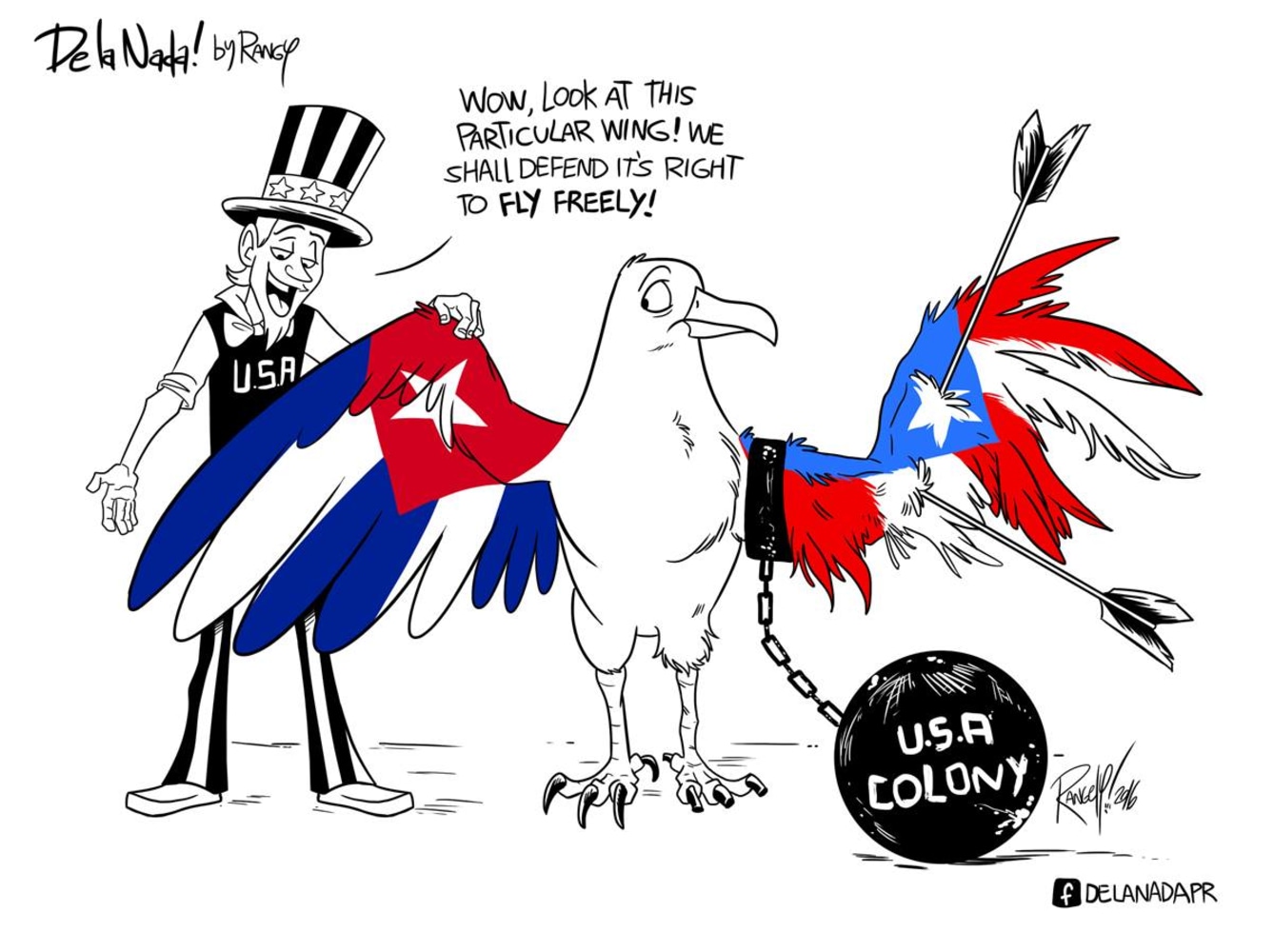
3. This last cartoon is about effect colonization has on the country as a whole. The artists makes it very clear that colonization is holding down the bird that represents the country's freedom, and that the bird cannot fly without both wings. It also emphasizes that Uncle Sam, who in this case represents the US government, is neglecting the broken wing, and is only paying attention to the perfectly good wing.
Subscribe to:
Posts (Atom)